A steam shower isn’t a fixture you add at the end. It’s a small, sealed room that runs hot and saturated every time you use it, and nearly everything that makes one work, or fail, sits behind the tile.
As a Westside custom builder, we plan steam before framing starts, not at finishes. Our 1041 Iliff rebuild in Pacific Palisades has one in build-out now. Here’s what goes into doing it right.
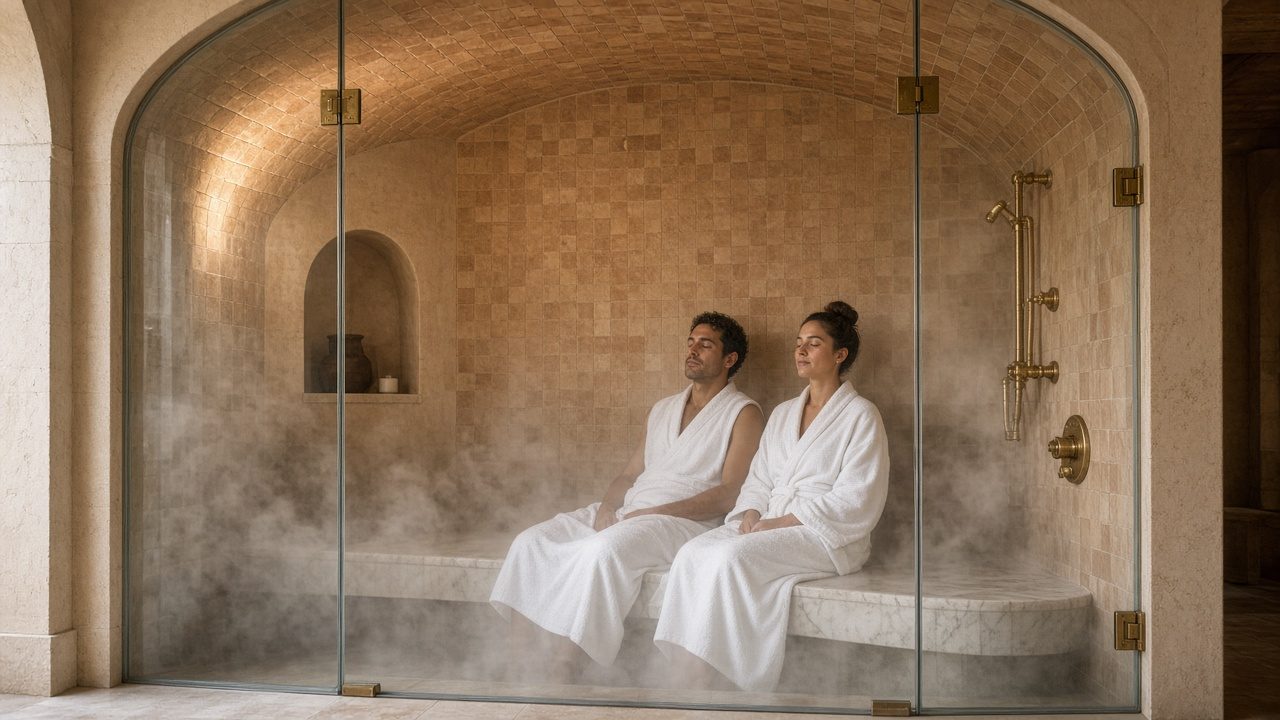
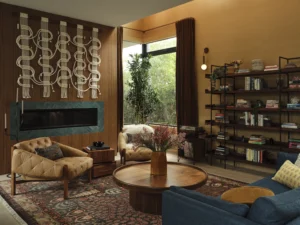
Fully sealed, glass to the vault: steam stays where it belongs. Illustrative image (AI-generated). Not an LA Design Build project.
Why steam is decided before framing
A regular shower deals with water running down the walls. A steam shower deals with hot vapor pushing into them. That changes the framing, the waterproofing, the ceiling, the glass, the electrical and the plumbing.
So the decision comes before the framing stage. The generator needs a dedicated electrical circuit, control wiring, a water supply, a drain and a steam line to the shower, and all of it has to be brought in while the structure is open. The generator’s location gets set at the same time.
Decide on steam during design and it’s a coordinated detail. Decide once the walls are up and it’s rework.
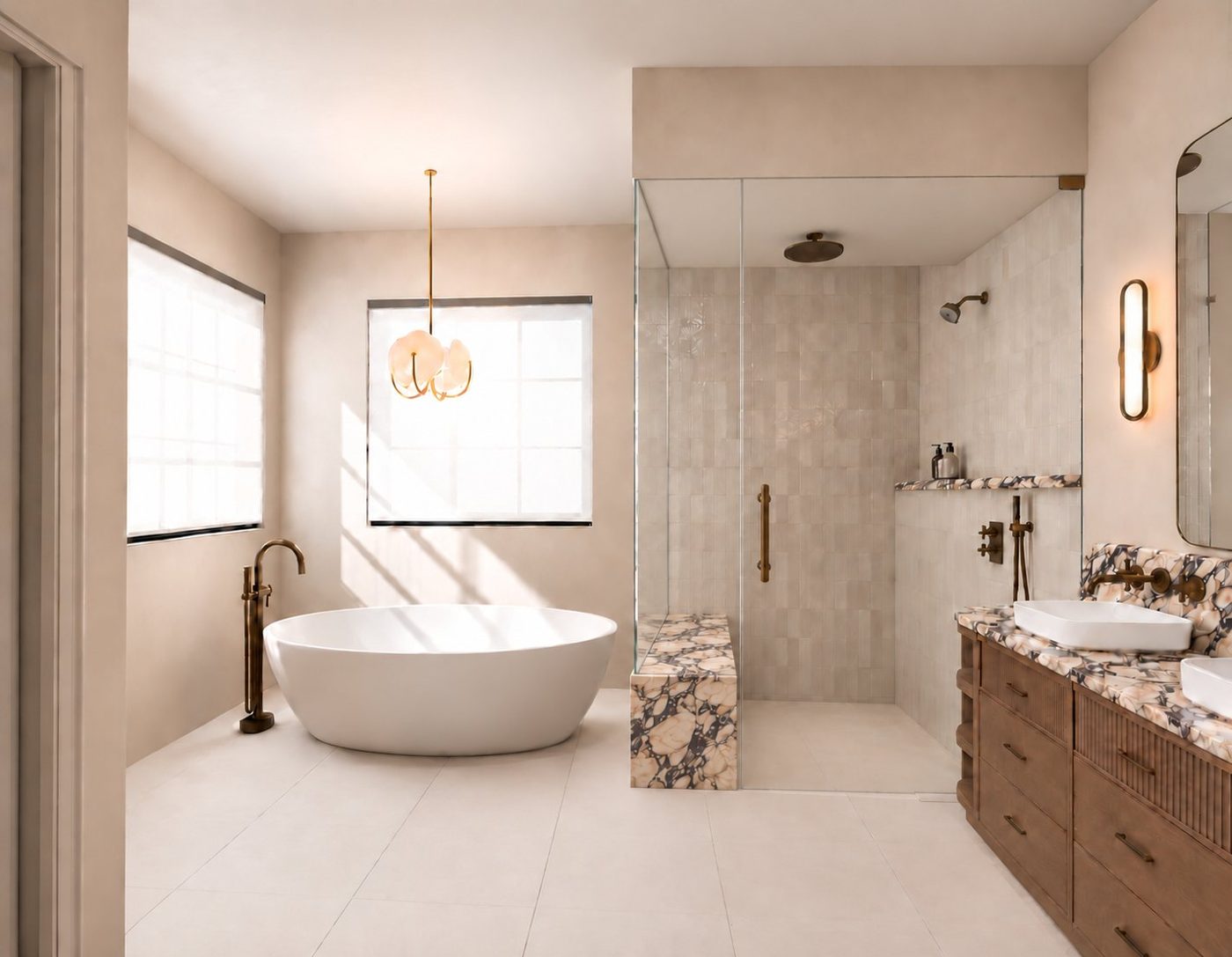
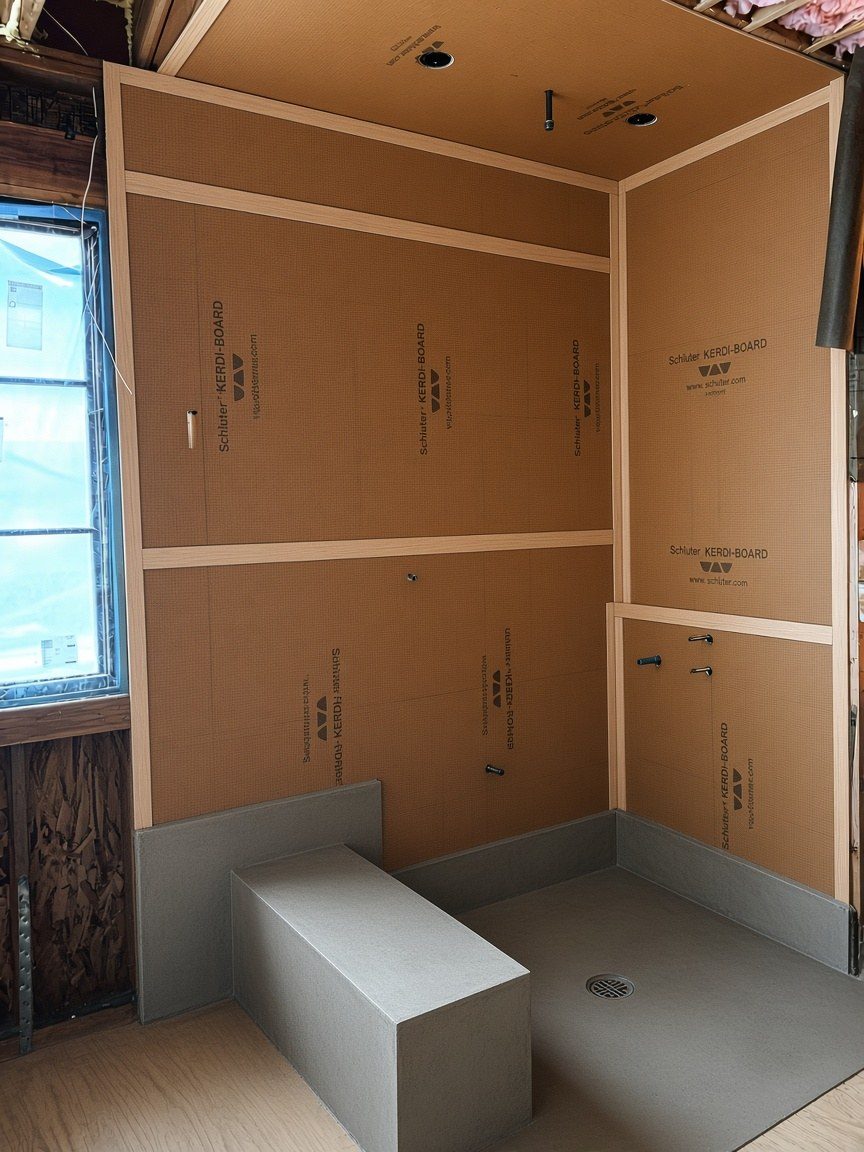
At 1041 Iliff: the design rendering, and the build-out behind it.
Design rendering of the finished primary bath and steam shower at our Pacific Palisades rebuild. LADB design rendering, 1041 Iliff St, Pacific Palisades.
Illustration of the steam shower build-out at our Pacific Palisades rebuild: Kerdi-Board walls and sloped ceiling, sloped mortar pan ready for tile. Illustration based on LADB jobsite photo, 1041 Iliff St.
The enclosure: build a room, not a stall
Steam needs to stay put. A steam shower is fully enclosed, floor to ceiling, with no open gap anywhere:
Glass to the ceiling. Glass panels and the door run full height to the ceiling or a solid soffit, with a door that seals. Glass that stops short of the ceiling works for a regular shower, never for steam: steam escapes over the top and the generator works harder to keep up.
Tile to the ceiling, and across it. Tile, or the waterproofed board behind it, runs full height on every wall and continues across the ceiling.
Venting you can close. ThermaSol recommends an exhaust fan or a transom window so steam can clear after a session, with any opening sealable during use.
Sealed penetrations. Every valve, control, light and steam head housing that passes through the wall needs to be sealed into the waterproofing.
Non-porous finishes. Porcelain, ceramic, glass and properly sealed stone. MrSteam notes that porous materials absorb heat and moisture and may call for a larger generator.
Window inside the shower? It can work, but it needs careful detailing. Exterior windows should be double-pane.
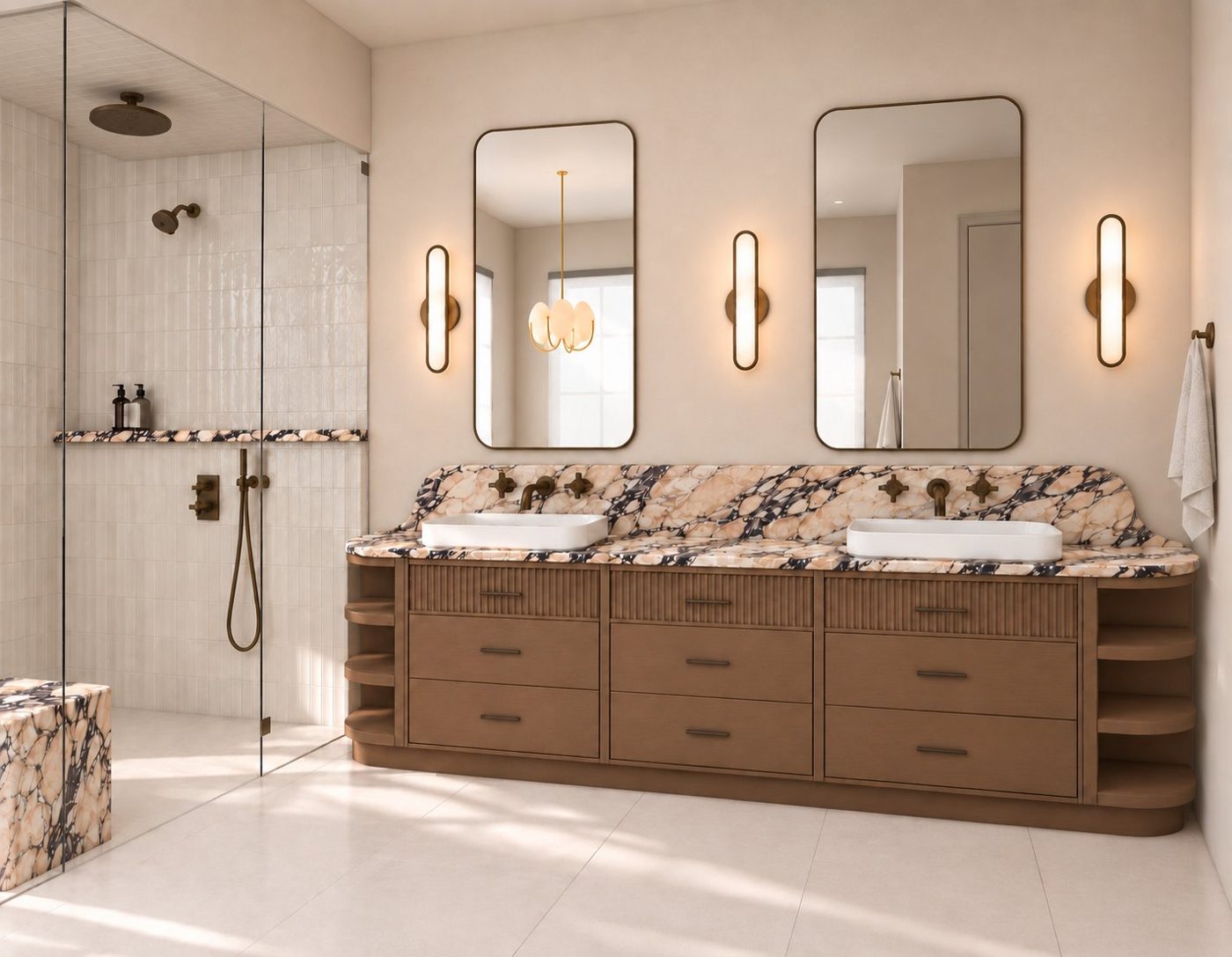
Design rendering of the primary bath vanity at our Pacific Palisades rebuild. LADB design rendering, 1041 Iliff St, Pacific Palisades.
Ceiling height and slope
Steam rises. A soaring ceiling looks great in a rendering, but the steam ends up up there and you don’t.
Height: MrSteam calls an 8-foot ceiling optimal. You can go up to about 10 feet, but the generator has to be upsized to compensate.
Slope: a flat ceiling collects condensation and drips cold water on whoever’s sitting below. ThermaSol recommends sloping the ceiling 1 to 2 inches per foot so condensate runs to the wall. The International Masonry Institute’s detail based on TCNA method SR614 shows 2 inches per foot. (MrSteam takes a lighter view for home use under about 45 minutes, so we’ll talk through how you plan to use yours.)
Slope the ceiling away from the bench, toward a wall, so the drip line lands somewhere harmless.
Waterproofing: the part you never see
This is where most of the risk lives, and where a builder earns the job.
A continuous, bonded waterproof membrane on walls, ceiling and floor.
Low vapor permeance. For continuous-use steam rooms, TCNA method SR614 calls for a membrane rated at 0.5 perms or less (tested per ASTM E96, Procedure E). If the membrane is above that, a secondary vapor retarder goes behind the tile substrate and laps over the shower pan.
Sloped floor to drain. The IMI/SR614 detail shows a pre-pitched mortar bed at 1/4 inch per foot. A linear drain is a clean way to get there.
Stiff framing. If steel studs are used, the SR614 detail calls for 20 gauge or heavier at 16 inches on center.
Get the waterproofing inspected and photographed before tile goes on. Once it’s covered, it’s covered.
The steam generator: where it lives matters
The generator is the engine, and it can’t go inside the steam room. It needs power, water, a drain line and service access for as long as you own the house, which is why its location is fixed before framing.
Location: in our homes, the generator usually goes in attic space or in a dedicated spot along a closet or close to the bathroom. ThermaSol’s current PRO Series III guidance calls for a finished, climate-controlled space protected from weather, with at least 6 inches of clearance on all sides, so an attic location has to be conditioned space, not an open, unheated attic.
Distance: manufacturers publish a maximum run from generator to steam head. ThermaSol, for example, allows up to 50 feet. Shorter is better, which is one more reason to keep it close to the bathroom.
Access: the unit sits flat and level and has to stay accessible. ThermaSol is explicit: don’t enclose it behind a wall or inside a bench.
Power: expect a 208–240V dedicated circuit. Always use a licensed electrician.
Plumbing: MrSteam specifies copper or brass for the steam line (no PVC or PEX), threaded unions for service, and reduced incoming water pressure.
Choosing the generator and controls
On our Pacific Palisades rebuild, we’re proposing a ThermaSol steam unit with a digital control. Here’s how ThermaSol’s current residential lineup breaks down.
The generator. ThermaSol’s residential steam generator is the PRO Series III, offered in sizes matched to room volume. ThermaSol lists Smart Steam temperature control, FastStart, constant steam output, a stainless steel tank with a self-cleaning PowerFlush system, and runs of up to 50 feet from the shower. It needs a 208–240V single-phase supply on a dedicated breaker.
Sizing. ThermaSol sizes by volume: length × width × height of the enclosure in cubic feet. Go up one size for a 9-foot ceiling and two for a 10-foot ceiling. ThermaSol says wall materials don’t change its sizing. Other manufacturers, including MrSteam, do factor in porous finishes, so size to the manual of the unit you actually buy.
The control. This is what you touch every day, so it’s worth choosing deliberately:
MicroTouch: steam-only, with a capacitive touch interface, a built-in 45-minute timer and temperature recall. The minimal option.
SignaTouch 5: a digital touchscreen that runs steam, audio, chromatherapy and lighting, with two customizable user profiles. Bluetooth is available when paired with a compatible ThermaSol rainhead. ThermaSol specifies mounting it inside the shower, 60 inches to center and as far from the steam head as possible.
ThermaTouch2 (7″, 10″ or 15″): ThermaSol’s flagship smart control. It handles steam, temperature, lighting and sound from one waterproof touchscreen, with Tranquility Scenes, streaming apps, Bluetooth audio, Alexa activation and personalized user settings.
Light, sound and scent. ThermaSol’s Serenity rainheads add chromatherapy and sound, HydroVive adds full-spectrum LED lighting and sound, and ThermaSol’s steam heads include an essential-oil reservoir for aromatherapy. Each is another rough-in and another penetration to seal, so pick them before the walls close.
Steam head, controls and the bench
Small placement choices decide whether your steam shower is relaxing or annoying.
Steam head: keep it away from where your body, feet and head will be, and off the bench. Height depends on the model. MrSteam suggests 6 to 12 inches above the floor, while ThermaSol’s SteamVection head goes at least 24 inches up. Follow the manual for the unit you choose.
Controls: put them near the bench, roughly 4 to 5 feet off the floor, and on a different wall from the steam head so the built-in sensor reads the room, not the plume.
Bench: MrSteam recommends at least 15 inches deep and about 18 inches high. A built-in bench is part of the waterproofed structure, so it has to be designed in from day one.
Extras: steam-rated lighting, chromatherapy, aromatherapy and moisture-resistant speakers are all available. Each one adds a penetration to seal, so choose them before the rough-in.
Outside the steam shower, plan a standard bathroom exhaust fan to clear moisture after each session.
What to plan for in the budget
Steam shower costs vary too much with size, finishes and equipment to give a useful number here. What we can tell you is what belongs in the scope, so nothing shows up later as a surprise:
Steam generator, sized to the room per the manufacturer’s method
Controls and any extras (lighting, audio, aroma)
Dedicated electrical circuit and plumbing runs
Vapor-rated waterproofing system and a sloped ceiling
Glass enclosure to the ceiling with a sealing door, plus a transom or vent that closes during use
Built-in bench and niches
A dedicated, serviceable generator location, in the attic or along a closet near the bath
In a fixed-price proposal, each of these should be listed so you can see exactly what’s included.
Bringing it home
A steam shower reads as pure luxury and works as building science. It rewards a team that designs, builds and finishes it together.
Can I convert my existing shower into a steam shower?
Sometimes. It depends on the ceiling, the enclosure, the waterproofing behind the tile and whether there’s an accessible spot for the generator. Usually it means opening the walls.
Does a steam shower need a sloped ceiling?
It’s strongly recommended. Manufacturers and the TCNA-based details call for a sloped ceiling to keep condensation from dripping on you.
Where does the steam generator go?
Outside the steam room. We usually place it in attic space or in a dedicated spot along a closet or close to the bathroom, kept accessible and within the manufacturer’s maximum distance. ThermaSol calls for a finished, climate-controlled location, so an attic spot needs to be conditioned.
When should I decide on a steam shower?
Before framing. Power, wiring, water, drain and the steam line all have to be brought in while the structure is open.
What kind of glass door do I need?
A fully enclosed, vapor-tight enclosure: glass to the ceiling or a solid soffit, a door designed to seal, and a transom or vent that closes during use. Never glass that stops short of the ceiling.
Can I use natural stone?
Yes, if it’s properly sealed and detailed. ThermaSol notes stone must be resealed regularly, and MrSteam notes porous materials absorb heat and moisture and may call for a larger generator.