**1. Designing Without Builder Input**
Architectural plans can look perfect on paper. But if construction realities aren’t integrated early, pricing and feasibility become guesses.
When builders enter the process too late, they inherit a design that wasn’t engineered for real-world construction.
That’s where major change orders begin.
**2. Undefined “Custom” Millwork**
Custom cabinetry is one of the largest cost variables in luxury homes.
Without detailed shop drawings, hardware specifications, and finish standards, the word “custom” becomes open to interpretation. That ambiguity almost always increases cost during fabrication.
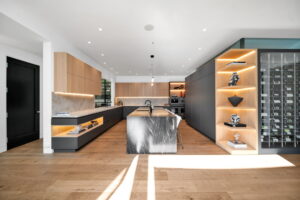
Projects across Hollywood Hills and Beverly Hills often require cabinetry that integrates lighting, appliances, and structural walls—details that must be resolved long before installation.
**3. Structural Surprises**
Opening walls in older Brentwood homes frequently reveals framing issues, outdated seismic standards, or foundation conditions that were never included in the budget.
Even relatively modern homes can hide structural complexities once walls come down.
A realistic renovation plan anticipates these possibilities early.
**4. Unrealistic Allowances**
Allowances are often used to keep early budgets attractive.
But when actual materials are selected—stone slabs, custom fixtures, integrated lighting systems—the difference between allowance and reality becomes obvious.
Those gaps can easily exceed six figures in a full home renovation.
**5. Poor Trade Coordination**
Luxury homes require precise sequencing between trades.
Stone fabrication depends on cabinet installation. Cabinet installation depends on framing accuracy. Lighting design affects drywall layout.
When trades work independently, delays multiply.
**6. Permitting Strategy Ignored**
Each neighborhood in Los Angeles has different review expectations.
Projects in Pacific Palisades may involve additional environmental review, while hillside homes in Bel Air or Hollywood Hills require careful structural planning.
Permitting strategy should guide design—not follow it.
**7. No Single Point of Accountability**
When architects, contractors, and specialty fabricators operate independently, no one truly owns the outcome.
That fragmentation leads to cost escalation, delays, and inconsistent results.
Design-build eliminates this problem by aligning design, engineering, and construction under one coordinated process.
**FAQs**
How much does a luxury home renovation cost in Los Angeles?
High-end renovations typically range between $450 and $900 per square foot depending on complexity, custom fabrication, and structural scope.
Why do renovation budgets increase during construction?
Budget increases usually come from incomplete early planning, undefined specifications, or structural conditions discovered after demolition.
Is design-build better for high-end projects?
Design-build reduces risk by aligning design decisions with construction realities from the start.